Home > FAQs > Design, Customisation & Visualisation > Page 3
From construction and materials to colour, sizing, customisation, care and production — explore the knowledge behind a bespoke rug.
Standard rectangular rugs have efficient loom processes. Non-rectangular shapes require additional hand-finishing, hand-cutting, edge-binding, or custom loom setup. The more complex the shape, the higher the labour and timeline. We quote shapes separately during design development.
Insets and multi-panel designs require precise loom coordination. We can do them, but they add complexity and timeline. The production team needs to understand exactly where each section begins and ends. This is manageable but takes planning. We discuss feasibility during design development.
Matching multiple rug types is smart for larger residential or hospitality projects. We can ensure colour consistency and design language across different constructions. Timelines may overlap or vary depending on the complexity of each rug. This is managed during project planning.
We accept images via email, cloud links (Google Drive, Dropbox), or WhatsApp for international clients. If you’re sent a portal login, images can be uploaded there for easy collaboration. Organise images logically (e.g., “Room Overview,” “Colour Palette,” “Furniture Detail”) to help us analyse quickly.
Low resolution is fine for initial direction-setting, but once we’re designing, clearer images help us understand your space, lighting, and colour palette better. If shooting specifically for us, natural daylight and multiple angles are helpful. We can work with most photo quality.
All client information and imagery is treated as proprietary. We maintain security protocols for digital assets. If we’d like to feature your project in our portfolio or case studies after completion, we ask explicit permission first.
Revisions typically involve tweaks to colour, scale, pattern density, or proportion. Major direction changes count as a new concept. We encourage getting it right before sampling to avoid costly production changes.
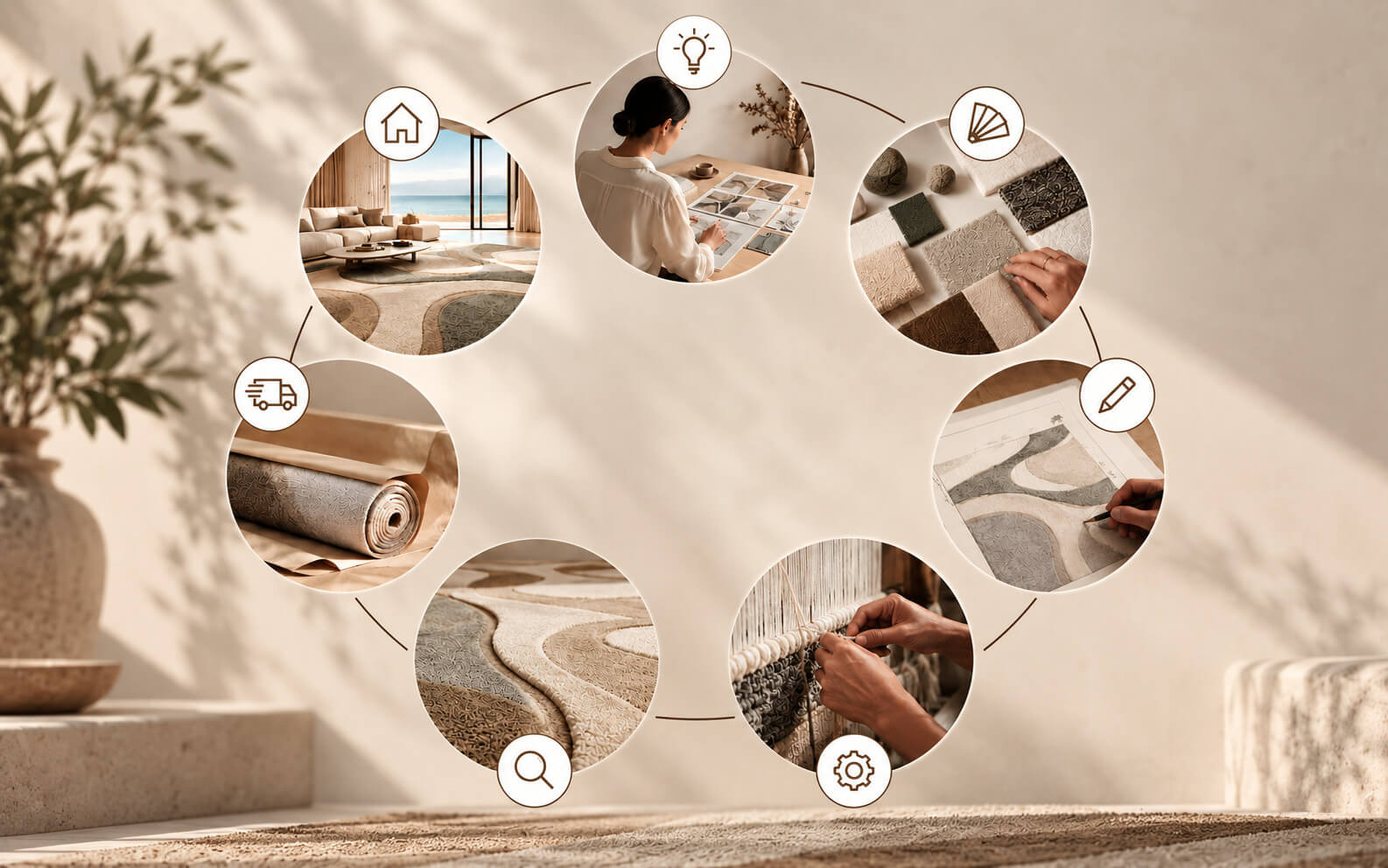
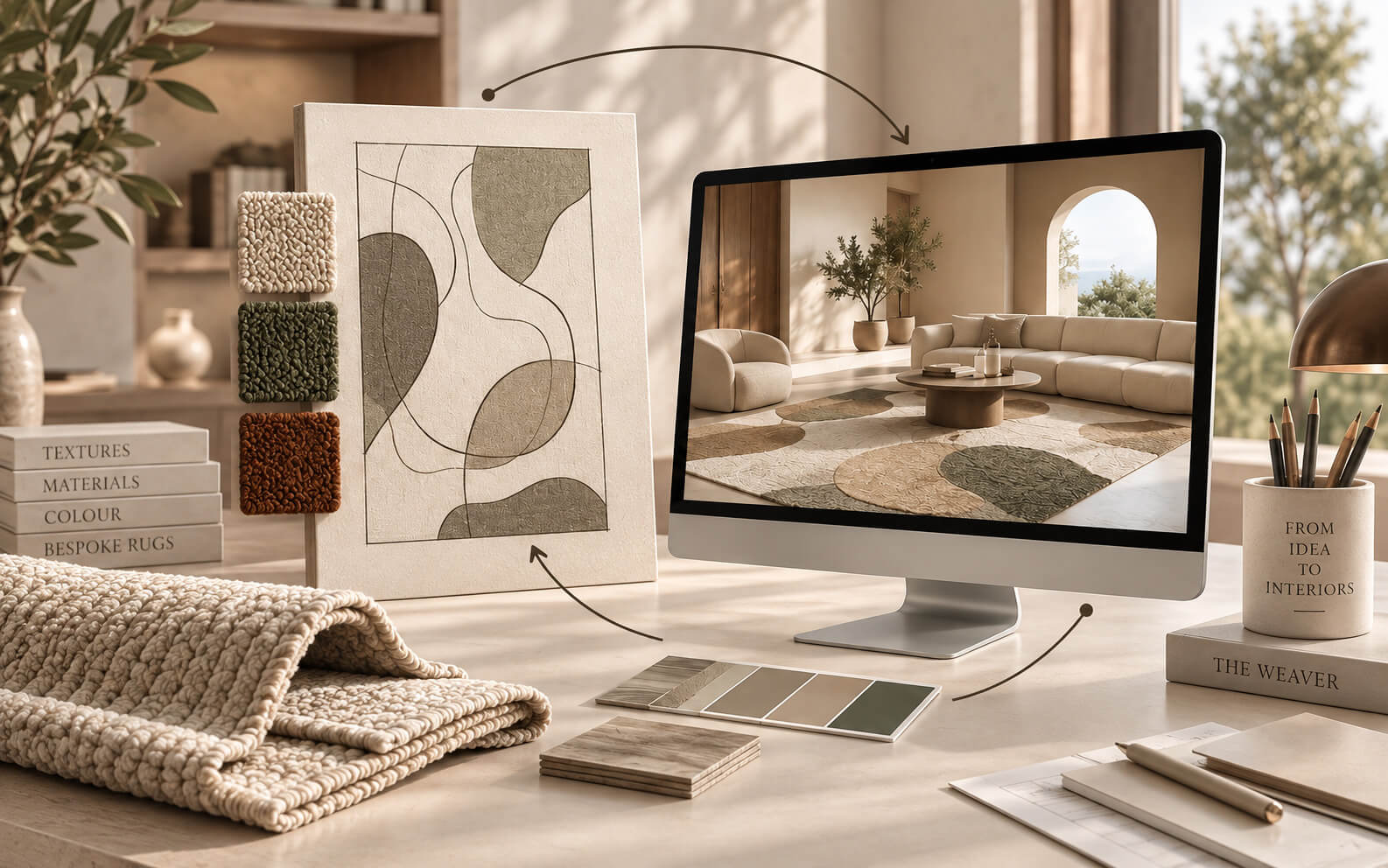
Room visualisations help you see the final result before production. We use your photos to place the rug realistically in your interior, showing colour integration, scale, and overall impact. This is especially useful for large projects or bold colour choices. Visualisations are provided as part of design development.
Once we begin production, dyes are prepared, looms are warped, and artisans are allocated. Design changes mid-production are disruptive and expensive. This is why we invest time in the design phase to ensure you’re completely satisfied before we commit to production.
We typically provide visualisations once the design is finalised but before we create physical samples. This gives you a realistic preview. Some projects request visualisations earlier in design development if they’re deciding between two design directions—we accommodate this.
Complete customisation is our core offering. You’re not selecting from stock options—you’re designing with us. The only constraints are material durability, loom capacity for certain sizes, and production feasibility. We’ll advise on what’s possible within your brief and budget.
Digital visualisations give 90%+ accuracy for how the rug design integrates into your room. Lighting in photos affects perceived colour, so samples show real-world accuracy. Visualisations are tools for confidence, not guarantees—the sample is the true preview.
We can customise almost everything. Hand-knotted rugs have maximum width limitations (~4m without seaming). Silk requires special care considerations. Natural materials have colour variation inherently. Our team will outline constraints during your consultation.
Non-standard shapes are achievable but require hand-finishing after production. Circular and oval rugs are common. Complex geometric or organic shapes take longer and cost more. We advise on feasibility during design development. Shapes are equally possible in all rug types.
This is common and actually smart. You’ve found a style you love; we ensure it fits your space and brief perfectly. We’ll analyse the original, understand what appeals to you, and propose modifications that enhance it for your specific project. No copyright concerns for personal residential use.
Whether it’s a pencil sketch, digital file, or concept you describe verbally, we can work with it. Our design team will translate your intent into a pattern and colour approach suitable for handmade rugs. We ask clarifying questions about scale, colour, and production feasibility.
Digital files are easier for us to work with, but we’re flexible. If you have high-resolution files, that’s ideal. For sketches, clear lighting and a straight angle help. We don’t require pixel-perfect submissions—we refine everything anyway.
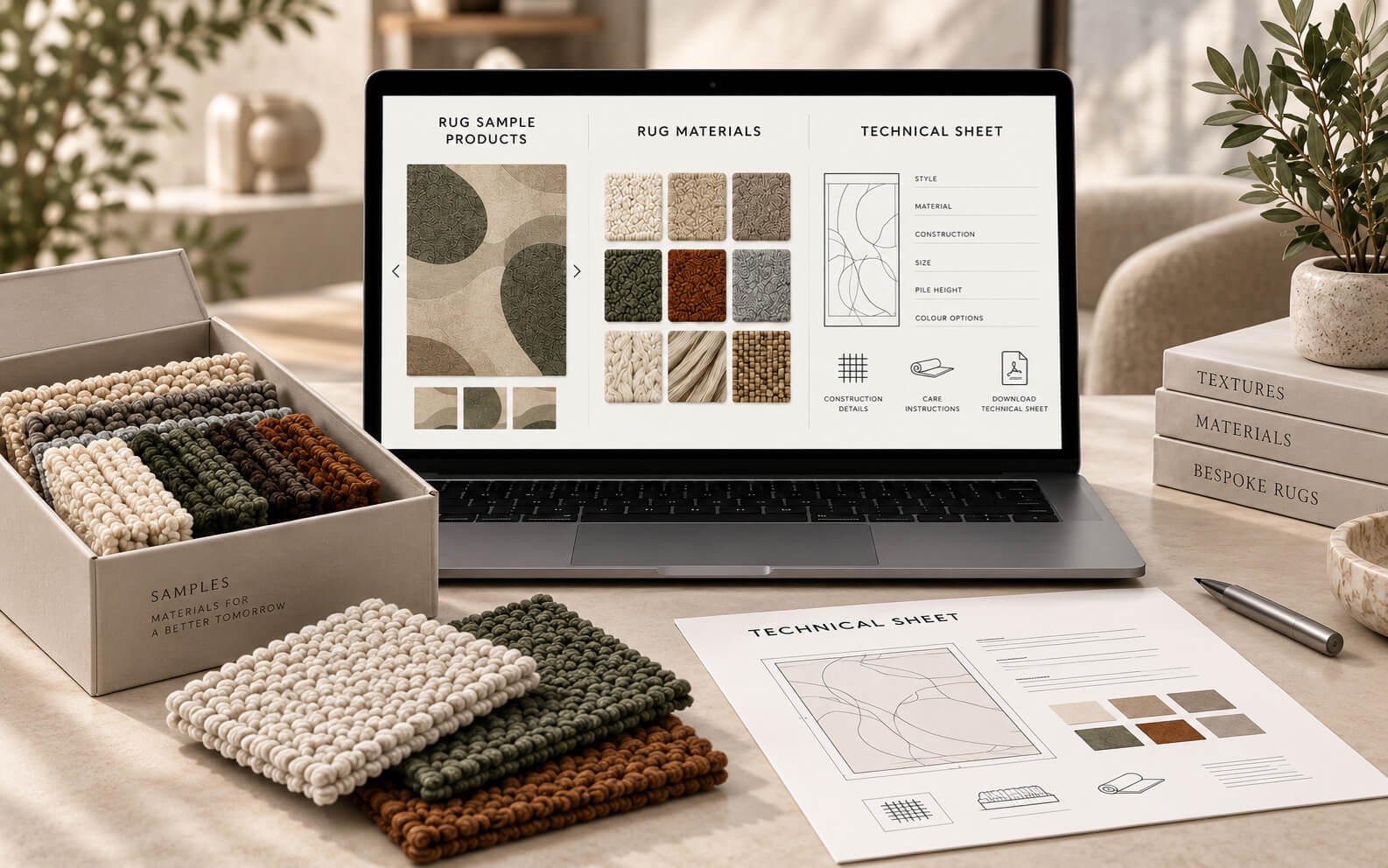
Exact matches vary by material and dye chemistry, but we’re skilled at achieving very close results. We always create a sample first to show colour accuracy before full production. Lighting conditions in photos also affect perceived colour, so we ask clarifying questions.
Our dye team has decades of experience matching colours across our material range. Hand-dyed materials like wool may have natural variation (which is part of their charm). We mitigate this through careful dye control and sampling before production. Synthetic colours are more uniform but equally customisable.
Our dye palette is expansive. We source colour inspiration from nature, art, fashion, and interiors. If you have a specific colour reference—a paint swatch, photo, fabric sample—we match it in our lab before committing to full production. Complex multi-colour designs are also standard.
Pantone swatches are useful but material-dependent. A Pantone red looks different on wool versus silk versus synthetic fibre. We always create a small sample to show you the actual colour outcome on your chosen material before proceeding.
Light bounces off silk differently than wool. Wool has a warm matte finish; silk has a lustrous sheen. Synthetics can be matte or glossy. These characteristics affect how colour reads. This is why material selection happens alongside colour selection. We’ll show you the difference with swatches.
Sometimes the ideal colour isn’t technically dyeable in your first-choice material. We work around this by either finding a material that works or adjusting your colour direction to complement your space while staying in your preferred fibre. Most projects find a happy balance.
Design development typically involves 2–3 rounds of concepts. You provide feedback on pattern, colour, scale, and overall direction. We iterate until the design resonates with your vision. Once approved, we move to material and colour sampling.
Initial concepts explore different aesthetic directions—pattern density, scale, colour approach, or layout. You select a direction you prefer, and we create detailed refinements within that concept. Additional concepts beyond this are quoted separately.
Find answers by the topic that matters to you.
Filter, explore, and discover the rug your space has been waiting for.
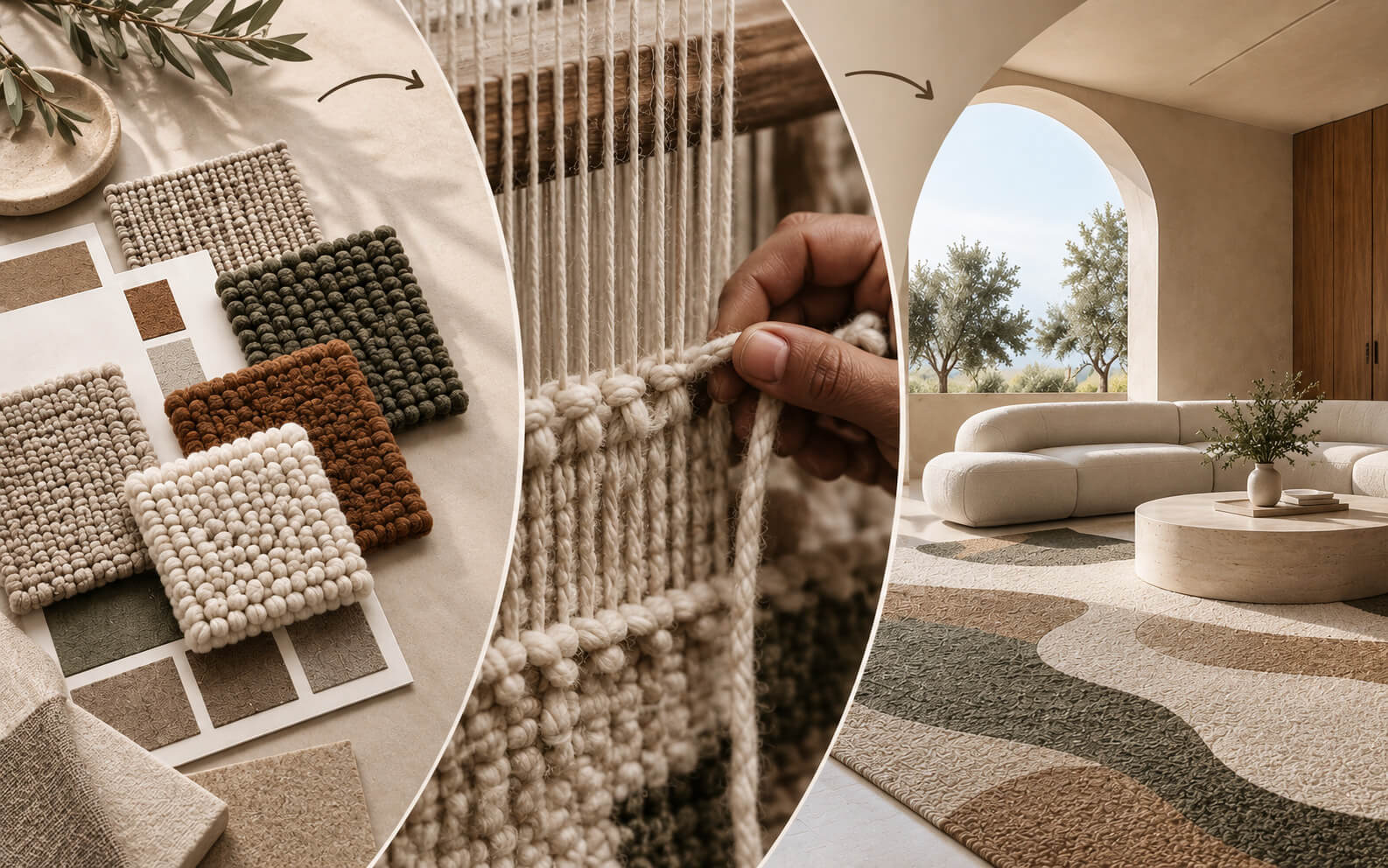
Share your design concept, moodboard, or sketch. Our craftsmen will translate it into a bespoke rug — any size, any material, any motif.
Tell us what you need. We’ll make it exist.
Customized rugs & carpets to match your unique requirements.